Beschreibung
Wien, (1922).
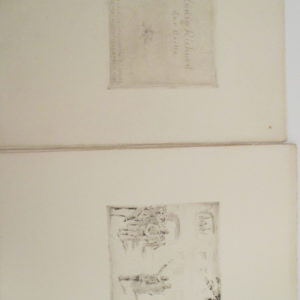
44 : 54 cm. Original-Farblithographie in Ocker und Schwarz Mit eigenhändiger Signatur.
280,00 EUR
Buch- und Kunstantiquariat
275,00 €
Ludwig Heinrich Jungnickel (1881 Wunsiedel – 1965 Wien) deutsch-österreichischer Maler und Illustrator, wurde vor allem durch seine Tierbilder bekannt. 1908 stellte er seine ersten Farbholzschnitte auf der Kunstschau in Wien aus, dem folgte 1908 eine Serie von Tierdarstellung aus dem Tiergarten Schönbrunn. Diese brachten ihm internationle Anerkennung ein. Er war auch Mitarbeiter der Wiener Werkstätte. – Zeigt zwei reitende Araber. Rechts unten in Bleistift signiert. Auf Bütten. – Rechte und oberer Rand teils gebräunt, Darstellung saueber. Jungnickel, bekannt für seine detailreichen Darstellungen von Tieren, fängt die majestätische Schönheit und das natürliche Verhalten seiner Motive in einzigartiger Weise ein. Seine Arbeiten zeichnen sich durch eine meisterhafte Technik und ein außergewöhnliches Gespür für Formen und Proportionen aus, was sie zu echten Sammlerstücken macht. Besonders die Tierdarstellungen sind künstlerisch wertvoll. The German-Austrian artist L. H. Jungnickel was the son of a carpenter. In 1885, the family moved to Munich, where he attended the School of Arts and Crafts. The archaeologist Orazio Maruchi enabled him to make copies of the paintings in the Vatican collections. The quality was so good that it was suggested that he train as a church painter. To this end, Ludwig Heinrich Jungnickel became a pupil at the Tanzenberg monastery near Klagenfurt. In 1899, he moved to Vienna and enrolled at the Vienna Academy in the General School of Painting under Christian Griepenkerl. Around 1900, he worked for the Cologne chocolate producer Ludwig Stollwerck, designing collectible Stollwerck pictures. After returning from a trip to Hungary, he enrolled with Alfred Roller at the Kunstgewerbeschule des k. k. Museums für Kunst und Industrie in 1902. In 1905 Jungnickel went to the Academy of Fine Arts in Munich under Professor Marr and returned to the Vienna Academy of Fine Arts (William Unger) in 1906. His breakthrough came with the publication of pictures in stencil spray technique, which he had invented after the art magazine The Studio. In 1906 he exhibited at the Vienna Secession, but never became a member. Collaborator of the Wiener Werkstätte. Probably his most important work for the WW were designs for an animal frieze for a children’s room in the Palais at the Palais Stoclet, Brussels. Jungnickel exhibited his first color woodcuts at the Vienna Art Show in 1908, followed by a series of color woodcuts of animals from the Schönbrunn Zoo in 1909. At the International Art Exhibition in Rome in 1911, he was awarded the graphic artist prize and in Amsterdam the gold medal. In Leipzig in 1914, he was awarded the State Medal of the Bugra International Exhibition of Decorative Arts and Graphic Arts and in San Francisco in 1915, the silver and bronze medals of the International Exhibition. In 1911, Ludwig Heinrich Jungnickel was appointed professor at the Graphic Arts Class in Frankfurt. In the same year, he presented color woodcuts with views of Frankfurt. In 1912, he returned to Vienna and worked on wallpaper designs, bookplates and animal woodcuts. Study trips took Jungnickel to Bosnia and Herzegovina in 1912 and to Hungary in 1914. During the World War, Jungnickel increasingly switched from graphic works to drawings with charcoal, chalk and pencil. At the end of 1915, he did six months of military service for Germany in the stage. In 1917, he produced a portfolio of six color woodcuts Animals of Fable, which were later expanded to include 24 color lithographs illustrating Aesop’s animal fables of classical antiquity and published in hardcover by Schroll in 1919. at the Palais Stoclet, Brussels. Jungnickel exhibited his first color woodcuts at the Vienna Art Show in 1908, followed by a series of color woodcuts of animals from the Schönbrunn Zoo in 1909. Ludwig Heinrich Jungnickel was granted Austrian citizenship at the 1911 International Art Exhibition in 1918. The Italian Sketchbook with 40 lithographs was published in 1921 and 1922 by Haybach-Verlag Vienna L. H. Jungnickel – Studien aus der Spanischen Hofreitschule. In the 1920s, he undertook numerous journeys that took him to Germany, Holland, Italy and Yugoslavia. In Italy and Yugoslavia, he mainly painted coastal landscapes. Apparently Jungnickel was also a student at the Bauhaus in Weimar; the annual portfolio of the Society for Reproducing Art in Vienna “Students of the Bauhaus”, published in 1919, contains his lithograph Reitschule. From 1924, Ludwig Heinrich Jungnickel was a member of the Vienna Künstlerhaus, where he took part in exhibitions. In 1930, he received the Austrian State Prize for Fine Arts and the Golden Medal of Honor of the Cooperative of Fine Artists Vienna, in 1937 the Grand Austrian State Prize for Fine Arts; in 1937, he participated in the Great German Art Exhibition 1937 in Munich with the drawing Dalmatian Donkey. As the president of the Vienna Künstlerhaus did not pass on As the president of the Vienna Künstlerhaus did not pass on his Aryan identity card to the authorities and he had presumably been denounced for having contacts with Jews, Jungnickel emigrated to Opatija. In the meantime, his apartment was evacuated by the Gestapo and his studio was destroyed in an air raid in 1945. Jungnickel was sentenced in absentia for “anti-state activities”. F
1 vorrätig
Wien, (1922).
44 : 54 cm. Original-Farblithographie in Ocker und Schwarz Mit eigenhändiger Signatur.
280,00 EUR